 Yesterday I sparred with a JKD stylist, and a former student of Ryan Kennedy. Adopting Hokko No Kamae, I managed to land a strong vertical elbow on his lead hand. He was indexing with his lead hand, but leaned in too far, giving me a direct shot to the back of his hand. I landed the elbow extremely hard and broke his hand. Gravity and elbows...work well.
Tuesday, March 31, 2009
JKD Fighter Incident
Yesterday I sparred with a JKD stylist, and a former student of Ryan Kennedy. Adopting Hokko No Kamae, I managed to land a strong vertical elbow on his lead hand. He was indexing with his lead hand, but leaned in too far, giving me a direct shot to the back of his hand. I landed the elbow extremely hard and broke his hand. Gravity and elbows...work well.

Monday, March 30, 2009
Choy Lay Fut Buk Sing
 Sifu Leung is beginning to reach out to the community, and advertise his teachings in Choy Lay Fut Buk Sing. He has much to offer, having fought bare knuckle in Hong Kong, and having learned under some great Masters. It is an honor to have found him, and his senior student, who have been very kind and welcoming. The striking style is utterly unique, extremely deceptive, and they are fighters through and through, encouraging conditioning and a fighting mentality. It has given me a better long range striking style, along with strikes that extremely difficult to defend against, due to their arching nature.
In "Bruce Lee", written by Jesse Glover, the author comments on how "Bruce met Richard , and that Richard's hard forearms were so powerful that both he (Bruce) and his fellow Si-hing (Senior student in Kung Fu) could not stop Richard's heavy swinging punches and were both knocked to the ground in a sparring/fight match."
How can you not train with someone of that history? Especially when you dislike Bruce Lee as much as I do (that's another article). Special thanks to Jenny Neiman, a wonderful photographer who took many great photos for our school. Her photos can be found on our main website.
Sunday, March 22, 2009
Pancrase Demonstration
Excellent MMA organization in Japan called "Pancrase." The co founder is Masakatsu Funaki. This is a demonstration of "Pancrase" style fighting. Pancrase predates the UFC.
Saturday, March 21, 2009
Making Technique Work
 A common criticism for Japanese Jujutsu is that it simply does not work against a fully resisting opponent. Without going into "Japanese Jujutsu" is a proven battlefield art, and therefore just somehow works, let's boil it down to a far more realistic perspective. Often what works and what does not work is not decided by the technique, but the training methodology that surrounds it.
For example, let us take the classic "double leg or single leg" takedown. The technique is as sound as "omote gyaku", in terms of principles. However, many train and drill a double and single leg takedown over and over, against fully resisting opponents. How often have you seen a Japanese Jujutuska practice omote gyaku in such a way, against people who don't want to be taken down? Seldom, if ever.
My argument is that training methodology is just as important as technique, if not moreso. In the summer of 2008 I fought a Brazilian Jiu-Jitsu practioner, and ended up taking him down with omote gyaku, which led to an arm bar/juji-gatame. Train your classical Jujutsu against uke who progressively resist more and more, and you will learn how to utilize such techniques in a real time manner.
Finally, simply because a technique does not work the first time around, or the 50th, do not dismiss it. Strong training with proper methodology can make many techniques work. Do not limit yourself to only using what is immediately easy, otherwise you limit yourself. As my teacher once said "there is a tendency to only accept techniques that are in your current range of ability. The problem with that is your range will never grow, nor will you." These photos are stills from the very same match I was just telling you about, where I managed a takedown with omote gyaku.


Shigurui Death Frenzy
I am not interested in all anime, but sometimes you have just have to...
This looks exceptional!
This looks exceptional!
Weapons Training

Weapons training, be it Filipino, Chinese, Okinawan, or Japanese, holds great purpose in the progression of a Martial Artist. I look at Weapons training as having three very basics advantages, and purposes that should encourage all to participate in such training. First, it is a fantastic workout. Weapons, depending on the make, wood, or material, can be of varying weights. Learning to control and manipulate such objects work the minute muscles in your body, targeting many areas that would not normally be targeted. My wrists and forearms have double in strength since weapon training, which started in the Okinawan system of Ryukyu Kobudo. Secondly, weapons training does not always dictate utilizing weapons, but can also be evading weapons. Learning to evade a stick, for example, is not only challenging but has tremendous benefits to when you need to evade a fist. The tip of a stick travels far quicker than a human fist. If you can learn to evade a stick, then as my teacher would say, "punches seem like they are coming at you in slow motion." The Filipino Martial Arts excel at such evasions and drills, and are a highly useable way to train for empty hand combat. Finally, simply learning to manipulate objects of varying sizes, lengths, and shapes increases the chance of you being able to find a weapon at your disposal, in the environment in which your combative situation takes place. An escrima stick/Hanbo/Jo/Bo/Tanbo etc, can all be relatively easy to find, as they are simply straight. Even specialized Okinawan weapons like the Tonfa can be found in every day environments, such as the back of your car. Nearly every car has a tire iron in it. Learn Tonfa, and you can wield a tire iron with devastating results.

Thursday, March 19, 2009
Cung Le vs Frank Shamrock
Cung Le vs Frank Shamrock. These are two extremely talented fighters, who both embody the spirit of Traditional Martial Arts, and the respect it brings. This is an extremely entertaining fight, with some truly show stopping moments and excellent technique. I will never forget watching this fight and being in awe of the gamesmanship and technique being displayed.
Part One
Part Two
Part One
Part Two
Wednesday, March 18, 2009
Hand Conditioning
 Fighting hurts, there is no way around it. The only hope is that you deliver a far greater beating than you receive. Forearm and fist conditioning is a useful element in your training. Not only does it make your bones and skin more resistant to breaking, but it also allows you to strike harder and with greater intention.
How does such training make you hit harder? While the physical benefits have been questioned by many, the mental element of such training is clear. Hitting someone bare knuckle hurts tremendously, and many street fights result in broken knuckles and hands. Strike someone with bone on bone, without any conditioning, and you will be less willing to strike them again. Getting used to the torturous feeling of high impact gives you a greater sense of what to expect. Get used to hitting hard things, and you will get used to the pain, to the point where it rolls off your shoulders. This makes annihilating someone's jaw easier to do, and makes blocking someone's punch a torturous affair for them, not you.
 While Buk Sing has given me a greater opportunity to practice conditioning, on a weekly basis, Karate has given me great forearm conditioning, due to the linearity of many of the techniques. With that said, my fist remains not terribly well conditioned, something I am rectifying. Conditioning of the forearms and fist should be taken slowly, and at a gradual pace, less a serious injury occur. There are many different ways to strike a makiwara, some involve direct strikes, others involve angling to engage different knuckles, others require a certain pushing sensation to ground and grind the knuckles down. It may seem strange, but the practice can become extremely meditative and very enjoyable.
Conditioning the hands makes you less likely to pull your punch out of the fear of pain. Without the fear of bone on bone contact, crashing through someone's guard becomes easier, and makes for one very terrified opponent.

Tuesday, March 17, 2009
Bas Rutten
 A few Bas Rutten quotes. Not only a phenomenal fighter in the ring or cage, but on the streets as well. Great individual to hang around, and a good teacher...very funny too...
"Because he tried to kill me, so I got to return the favor..."
"Look Sir, I really don't want anything of this and I go 'WHOOP' like this, and I slit your throat, and it's over and out..."
"Right away you say, 'OK I'm sorry'... Bang! Bang! Bang! No I'm not!"
"I'm sorry sir, but I'm going to break your leg..."
"Everybody underestimates the kick to the groin..."
"This guy head butted me, so i head butted him back twice..."
Kamae

No matter what Martial Art you may study, you are most likely familiar with the "Kamae". Kamae refers to "stance", "body attitude" etc. However, when we think of Kamae we often think of the physical posturing, and not the mental or spiritual posturing. Every Kamae has a feeling to it. In Karate, your kumite dachi is about posture, solidity, and firmness in resolve. In Ninpo, a Kamae such as dokko no kamae gives the sense of intensity and aggressiveness. Try to embody the feeling and mood that your Kamae gives you. It is not just a physical manifestation, but should excude how you the Kamae makes you feel inside.
During sparring in Karate, I have often felt myself on the loosing end of an exchange. As oppposed to looking frustrated or injured, I adopt a strong kumite dachi, telling my opponent that regardless of what has just happened, I am ready again, and unaffected. I think sparring provides a better understanding of Kamae, as they become living moving feelings as opposed to static physicality. I remember fighting one Karateka who adopted a really low stance, and moved towards me like he was going to unleash hell. He didn't end up being the greatest fighter, but for a moment, I was very intimidated.
Monday, March 16, 2009
Takamatsu's Words

Toshitsugu Takamatsu once said...
“Let him cut your skin, and you cut his flesh. Let him cut your flesh, and you cut his bones. Let him cut your bones, and you cut off his life.”
My interpretation of these words speaks about the importance of escalating violence against a would be attacker. When fighting, it is important to dominate the spirit of your opponent, as well as their physical shell. One of the best ways to dominate the spirit and body is by escalating any trespasses, with double the force. If struck in the leg, strike back twice as hard, twice as often. Let your opponent know you have a salvo of weapons and can fire off at will. As a fighter, I know the frustrations of fighting hard, only to have the opponent fight back harder, and give back double.
In recent times there has been a movement that have attempted to portray Takamatsu as a Saint, a dreamer, a poet, and a painter. He killed people. He was a fighter. We tend to forget such things when all Hatsumi talks about is prancing bunnies, and how softly Takamatsu used to whisper in his ear...
Takamatsu is an idol of mine, but not because of his artwork or his wisdom in the later years. It is because he trained and fought hard, because he won and took the transmission of his art seriously.
Sunday, March 15, 2009
Demon's Sermon On The Martial Arts
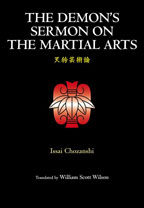
The Demon's Sermon on the Martial Arts, by Issai Chozanshi, is a fine example of Samurai literature. The book sets itself apart from other such works of the era, by offering no thoughts on combative techniques or strategies. Instead, it attempts to convey the importance of spirit in the Martial Arts, the importance of the mind and spirit.
The advice provided in the book is given by the Tengu, mythical winged beasts in Japanese folklore. While terrible in appearance and conduct, it was also said that the Tengu held the highest secrets of the Martial Arts and swordsmanship. These shape-shifters often took the form of big birds, with beaked faces, feathered wings and heavy talons, and their human form often had long noses; indicating both an avian heritage and an addiction to arrogance (Long Nose). Seeing as how the Tengu are the givers of the sermons in the book, it provides for playful dialogue filled with analogies, metaphors, and misleading dialogue. The book can be a chore to get through if you are looking for an easy read, but well worth it for those who wish to study.
As mentioned, the book provides no thoughts on techniques. Rather, the reader is advised on the importance of mind and spirit. He is not to be distracted by efficacy of technique, or any supposed superiority of one school over another. While technique certainly has its place, and it is often those who are left for dead that never focused on it, the book does bring about important concepts.
As my one instructor would say, and I could not agree more, tales abound of the Martial Artist that gets beaten up in the streets. I have personally encountered many such stories, and while these Martial Artists are often those who train with complete co-operation, no conditioning, unrealistic drilling, and no sparring, they are often those who lack in another area...
They neglect to train the spirit of combat, and the mind of combat. Such training does not mean sitting in meditation and opening useless chakras, it means training with intention and spirit. It means training with Zanshin, Isshin, Fudoshin, and Mushin.
When we train in the dojo with intensity of spirit and focus of mind, we learn how to exude combative spirit. We learn how to display the "I am going to fuck you up" spirit and look. Trained Martial Artists often lose in the streets because they do not train with intensity, the kind of spiritual, mental, and emotional intensity one finds in a combative scenerio. If you face an opponent with less technique, but greater spirit and drive and intention, regardless of your technique, you can lose. You can know all the technique in the world, but if you are not mentally prepared, and face a less talented yet mentally prepared opponent, your time is numbered. Thugs, gang bangers, criminals, they can all be difficult adversaries because they exude spirit to fight and mental hardening, and that can be intimidating. Intimidation in combat means you forget your techniques, and resort to wild movements. Train with intensity and hardness so that nothing intimidates you, because you have "seen it all before." Such an outlook will prepare you to be at your best, technique wise, in combat.
Defeat them with technique, but land the initial blow by showcasing your spirit to fight, which if you train it properly, will trump theirs.
The Demon's Sermon On The Martial Arts reminds us of such important things.
Subscribe to:
Posts (Atom)
